
 Conference TEHI, November 07-08-Samarkhand, Uzbekistan
Published In : Oct 30, 2025
WUST Co-Organizes TEHI 2025: Driving Innovation at the Crossroads of Electronics and Health Informatics
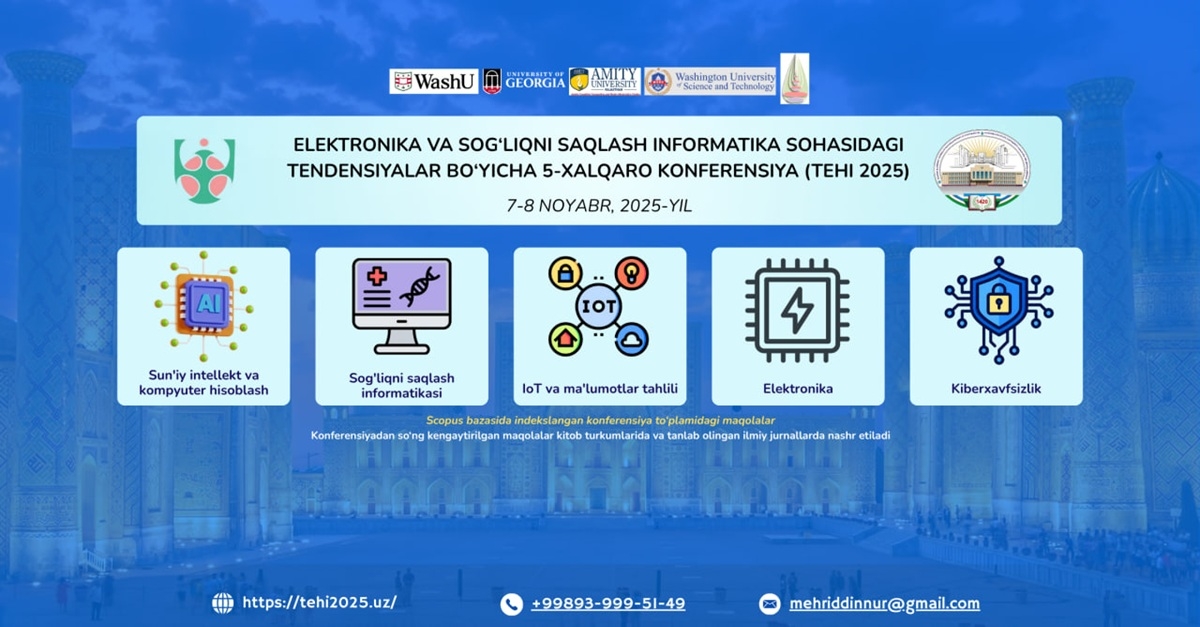
Alexandria, VA | November 7– 8, 2025, Washington University of Science and Technology (WUST) proudly co-organized the 5th International Conference on Trends in Electronics and Health Informatics (TEHI 2025), a landmark hybrid event held at Samarkand State University named after Sharof Rashidov, Samarkand, Uzbekistan. Bringing together researchers, engineers, healthcare professionals, and academics from around the globe, the two-day conference served as a premier international forum for advancing knowledge across the intersecting domains of electronics, biomedical engineering, artificial intelligence, cybersecurity, and health informatics.
TEHI 2025 was hosted by Samarkand State University and organized in collaboration with Washington University of Science and Technology (WUST), Virginia, USA, the University of Georgia, Amity University Jaipur, Washington University in St. Louis, and the International Institute of Invincible Rhythm, a coalition of institutions united by a shared commitment to research that advances human health and technological innovation.
In a particularly significant moment for WUST, Engr. Abubokor Hanip, Chancellor and Chairman of Washington University of Science and Technology, delivered a keynote address to the conference, bringing the university's highest leadership voice to the global stage of health informatics and AI research.
A Global Forum for Electronics and Health Informatics
Held in hybrid mode, TEHI 2025 combined vibrant in-person engagement at Samarkand State University's Faculty of Artificial Intelligence and Digital Technologies with virtual participation from researchers worldwide via Zoom. The conference's inclusive format enabled scholars from across Uzbekistan, Bangladesh, India, Russia, Turkey, China, Australia, Malaysia, South Africa, and the United States to contribute to and benefit from a rich two-day program.
TEHI 2025 explored experimental, theoretical, and practical aspects of innovation across five core research themes:
-
Artificial Intelligence and Machine Learning Applications, showcasing cutting-edge AI models for diagnostics, image analysis, disease detection, and intelligent data processing
-
Healthcare Informatics and Biomedical Systems, advancing AI-driven clinical decision support, diabetes prediction, biosensor technologies, and patient outcome modeling
-
Natural Language Processing and Human-Centered AI, exploring large language models, privacy-preserving NLP, sentiment analysis, and sign language interpretation systems
-
Smart Systems and Computing Optimization, covering intelligent computing architectures, IoT applications, edge computing, and optimization methods
-
Deep Learning and Medical Image Analysis, presenting research in tumor segmentation, diabetic retinopathy grading, polyp detection, breast cancer classification, and ECG interpretation
Additional Day 2 sessions addressed Neural Network Modeling and Computational Intelligence and Quantum Computing, GPU Acceleration, and Security Systems, reflecting the conference's broad and interdisciplinary scope.
WUST Chancellor Delivers Keynote Address
In a highlight of the conference, Engr. Abubokor Hanip, Chancellor and Chairman of Washington University of Science and Technology, delivered an online keynote address on Day 2 of TEHI 2025, titled:
"Empowering the Next Generation: AI-Driven Skill Transformation for a Smarter Workforce"
Chancellor Hanip's address spoke directly to one of the most pressing challenges facing higher education and industry alike: ensuring that the rapid advancement of artificial intelligence translates into genuine human empowerment rather than displacement. Drawing on WUST's Triple Mission of Degree, Skill, and Career, he articulated a vision for AI-driven education that equips graduates not merely with technical credentials, but with the adaptive skills and critical thinking needed to thrive in an intelligent, rapidly evolving economy.
The Chancellor's keynote was one of nine distinguished keynote addresses delivered across the two days of TEHI 2025, alongside contributions from scholars and leaders representing universities and organizations in the USA, Turkey, India, Russia, and Uzbekistan.
Distinguished Keynote Program
TEHI 2025 featured a remarkable lineup of keynote speakers whose expertise spanned technology, healthcare, quantum computing, and AI policy:
Day 1 Keynotes:
-
Professor Vincent Chang, Chairman of a US hedge fund, "The Road to Samarkand, On Technology, Cultures, and the Making of Prosperity", offering a rare perspective on the intersection of technology, geopolitics, and economic development
-
Besnik Limaj (Online), "The Guardians of the Digital Future: Building Cyber Resilience in a Hyper-Connected World"
-
Professor Akmal Akhatov, Vice Rector for International Cooperation, Samarkand State University, "Driver Drowsiness Detection Using AI Based on Multimodal Data"
-
Professor Urunbayev Erkin, Samarkand State University, "A Logical Method for Identifying All the Interrelated Conditions Between Symptoms and Diseases"
-
Zhuo (Adam) Chen, University of Georgia, USA, "Economic Evaluation of Health Informatics Systems"
-
Associate Professor Changle Li, Fujian Medical University, China, "Urban-Rural Disparities in Public Distrust of Physicians and Healthcare Utilization"
-
Lili Kang, PhD, Fujian Medical University, China, "Self-Rated Health and Its Key Determinants Among Middle-Aged and Older Chinese Adults Newly Diagnosed with Chronic Disease"
Day 2 Keynotes:
-
Professor Dr. Tyler S. Wallace (Online), "Moving from Pilot to Practice: Gen AI Adoption and Training Strategies"
-
Professor Dr. Mohammad Rifat Haider (Online), "Application of Big Data Analytics to Predict and Prevent STI Infections Among People Living with HIV in Georgia, USA"
-
Engr. Abubokor Hanip, Chancellor, WUST (Online), "Empowering the Next Generation: AI-Driven Skill Transformation for a Smarter Workforce"
-
Professor Uddin Izhar, "Applications of Fixed Point Theory to Signal and Image Recovery"
-
Professor Aswani Kumar Cherukuri (Online), "Migration to Post-Quantum Cryptography"
-
Professor Anirban Bandyopadhyay (Online), "From Bits to Clocks: Toward Natural Intelligence Beyond Self-Correcting LLMs"
WUST Faculty Research on Display
WUST's participation in TEHI 2025 extended well beyond the organizational and leadership levels. WUST faculty and affiliated researchers contributed directly to the conference's technical program, with papers presented across multiple sessions:
-
"Multi Domain Patch-Dropout: A Simple Input-Space Regularizer That Improves Robustness Under Missing Data", Md Muntaqim Meherab, Nuruzzaman Faruqui, Tanvirul Islam, Touhid Bhuiyan, Washington University of Science and Technology
-
"LightXNet: A Lightweight Deep Learning Approach for Pneumonia Detection", Aminur Sarker, Abu Zahid Md Jalal Uddin, Dr. Touhid Bhuiyan, School of IT, Washington University of Science and Technology
-
"RVE: An Optimized Ensemble Model for Breast Cancer Detection", Jalal Ahmmed, Faruk Ahmed, Md Alamgir Kabir, Abu Zahid Md Jalal Uddin, Touhid Bhuiyan
These contributions reflect the depth and practical relevance of WUST's active research program in applied AI, machine learning, and intelligent healthcare systems, making WUST not just an organizational partner in TEHI 2025, but a genuine intellectual contributor to its scientific output.
Strong Leadership and Inaugural Ceremony
The conference opened with a formal inaugural ceremony attended by distinguished guests including the Rector of Samarkand State University, Khalmuradov Rustam Ibragimovich, the Vice Rector for International Cooperation, Akhatov Akmal Rustamovich, Conference Chair Prof. Kanad Ray (Amity University Rajasthan), and several heads of faculty and department from across Samarkand State University.
Technical sessions were chaired and moderated by an international panel of academics from Bangladesh, India, Australia, Malaysia, the United Kingdom, Turkey, and Uzbekistan, ensuring a globally representative and rigorously managed program throughout both days.
Publication and Academic Impact
Selected papers presented at TEHI 2025 are published in Springer proceedings (Scopus indexed), ensuring enduring visibility and academic impact for the research shared at the conference. The Springer publication channel places TEHI 2025 within a prestigious tradition of peer-reviewed scholarly output and provides WUST-affiliated researchers with internationally recognized publication credits.
Strengthening WUST's International Research Presence
TEHI 2025 represents another significant chapter in WUST's growing international research engagement. From co-organizing landmark conferences in India and Uzbekistan to hosting events on its own Alexandria campus, WUST is building a presence as a globally active, research-driven institution whose reach extends far beyond its Virginia base.
Chancellor Hanip's keynote appearance at TEHI 2025 in Samarkand was a powerful symbol of this commitment, the university's most senior leader speaking directly to an international audience about the responsibility of higher education institutions to harness AI for human flourishing. It reflects precisely the kind of scholarly-leadership engagement that distinguishes WUST's approach to research: not just supporting knowledge creation, but championing its application to the challenges that matter most.
WUST is proud of its partnership with Samarkand State University and the broader TEHI community, and looks forward to continued collaboration as the conference series continues to grow in scope, geographic reach, and scientific impact.
About the TEHI Conference Series
The International Conference on Trends in Electronics and Health Informatics (TEHI) was founded in 2021 at Pranveer Singh Institute of Technology, Kanpur, India. Now in its 5th edition, TEHI has grown into a globally recognized, Springer-indexed conference series, with proceedings distributed to researchers worldwide. TEHI 2026 is scheduled for September 23–25, 2026.
For more information about TEHI 2025, visit tehi2025.uz | To learn more about research at WUST, visit research.wust.edu